

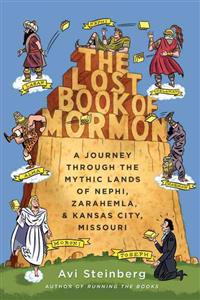
The Lost Book of Mormon: A Journey Through the Mythic Lands of Nephi, Zarahemla, and Kansas City, Missouri (Inbunden)
avAvi Steinberg
ISBN: 9780385535694 - UTGIVEN: 2014-10Is the "Book of Mormon" the Great American Novel? Decades before Melville and Twain composed their great works, a farmhand and child seer named Joseph Smith unearthed a long-buried book from a haunted hill in western New York State that told of an epic history of ancient America, a story about a fam[...]

Across the Wide Missouri (Pocket)
avBernard Augustine De Voto
ISBN: 9780395924976 - UTGIVEN: 199809Winner of the Bancroft Prize De Voto weaves a compelling story of the Rocky mountain fur trade during the 1830s, vividly showing how this frontier enterprise shaped the American West. (A Mariner Reissue)[...]

The Trailsman #372: Missouri MasterMind (Pocket)
avJon Sharpe
ISBN: 9780451414359 - UTGIVEN: 2012-10When the Pinkertons ask Skye Fargo to infiltrate a small gang of brutal killers, he has no idea what he's in for. Because the gang is only a tiny piece of a much bigger "syndicate" that has its filthy hands in a lot of pies--and it's up to the Trailsman to climb up the lowlife ladder and take down t[...]

Current Methodological Developments of Statistics in the Social Sciences (Inbunden)
avS. Kolenikov, Columbia, Missouri
ISBN: 9780470148747 - UTGIVEN: 2009-10-31
Three Billboards Outside Ebbing, Missouri
ISBN: 9780571345298 - UTGIVEN: 2017-12After months pass without a culprit in her daughter's murder case, Mildred Hayes pays for three signs challenging the authority of William Willoughby, the town's revered chief of police. When his second-in-command, Officer Dixon, a mother's boy with a penchant for violence, gets involved, the battle[...]

Bleeding Kansas, Bleeding Missouri
ISBN: 9780700619290 - UTGIVEN: 2013-08Long before the first shot of the Civil War was fired at Fort Sumter, violence had ?already erupted along the Missouri-Kansas border--a recurring cycle of robbery, arson, torture, murder, and revenge. This multifaceted study brings together fifteen scholars to expand our understanding of this vitall[...]

"USS Missouri" at War (Häftad)
ISBN: 9780760332191 - UTGIVEN: 2008-10On September 2, 1945, surrender ceremonies officially ending WW II in the Pacific were broadcast from the deck of the USS Missouri. This ceremony also marked the end of one of the most eventful years for any vessel in the history of warfare. "USS Missouri At War" chronicles the career of this mighty[...]

Uss Missouri Bb-63
ISBN: 9780764355622 - UTGIVEN: 2018-07The story of the USS Missouri, one of America's most famous warships of the twentieth century, and the world's last battleship, is told from her inception in 1940, through WWII kamikaze attacks, to her being the location of the Japanese surrender in Tokyo Bay, on September 2, 1945. Missouri's post-W[...]
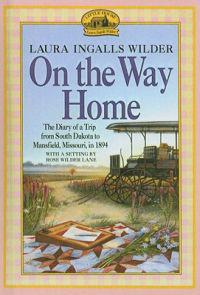
On the Way Home: The Diary of a Trip from South Dakota to Mansfield, Missouri, in 1894 (Inbunden)
avLaura Ingalls Wilder
ISBN: 9780780708976 - UTGIVEN: 1976-10

A Fur Trader on the Upper Missouri
ISBN: 9780803244276 - UTGIVEN: 2017-09A Fur Trader on the Upper Missouri offers the first annotated scholarly edition of Jean-Baptiste Truteau's journal of his voyage on the Missouri River in the central and northern Plains from 1794 to 1796 and of his description of the upper Missouri. This fully modern and magisterial edition of this [...]

Fur Traders, Trappers, and Mountain Men of the Upper Missouri (häftad)
ISBN: 9780803272699 - UTGIVEN: 1995-03
Forty Years a Fur Trader on the Upper Missouri (Pocket)
avCharles Larpenteur
ISBN: 9780803279308 - UTGIVEN: 1989-04"The life-record kept by Charles Larpenteur is one of our most important sources of information concerning the fur trade of the Upper Missouri in the nineteenth century."--Milo Milton Quaife The son of French immigrants who settled in Maryland, Charles Larpenteur was so eager to see the real America[...]
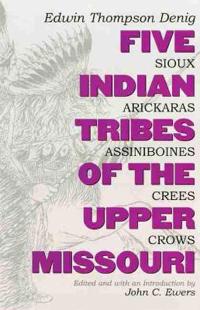
Five Indian Tribes of the Upper Missouri
ISBN: 9780806113081 - UTGIVEN: 1976-02Edwin Thompson Denig, for more than twenty years a fur trader on the Upper Missouri and married to an Assiniboine woman, was an acute and objective observer of Indian manners and customs. He assisted Audubon and the Culbertsons in collecting Missouri River fauna, supplied information on the Indians [...]

The Fur Trade on the Upper Missouri, 1840-1865
ISBN: 9780806125664 - UTGIVEN: 1993-09"By beginning where the standard works leave off and carrying the story up to its logical conclusion in 1865, this book fills a definite void in the history of the fur trade in the American West. Set in the upper Missouri country, which was bypassed by settlement until the 1860s, it focuses primaril[...]

Fort Union and the Upper Missouri Fur Trade (Pocket)
avBarton H. Barbour
ISBN: 9780806134987 - UTGIVEN: 200209In this book, Barton Barbour presents the first comprehensive history of Fort Union, the nineteenth century's most important and longest-lived Upper Missouri River fur trading post. Barbour explores the economic, social, legal, cultural, and political significance of the fort which was the brainchil[...]

Wild Bill Hickok, Gunfighter: A Trading Post on the Upper Missouri (häftad)
ISBN: 9780806135359 - UTGIVEN: 2003-05"James Butler Hickok, generally called 'Wild Bill, ' epitomized the archetypal gunfighter, that half-man, half-myth that became the heir to the mystique of the duelist when that method of resolving differences waned. . . . Easy access to a gun and whiskey coupled with gambling was the cause of most [...]

Terrible Justice: Sioux Chiefs and U.S. Soldiers on the Upper Missouri, 1854-1868 (Häftad)
avDoreen Chaky
ISBN: 9780806146522 - UTGIVEN: 2014-09They called themselves Dakota, but the explorers and fur traders who first encountered these people in the sixteenth century referred to them as Sioux, a corruption of the name their enemies called them. That linguistic dissonance foreshadowed a series of bloodier conflicts between Sioux warriors an[...]

The Missouri Expedition 1818-1820: The Journal of Surgeon John Gale and Related Documents (Häftad)
avJohn Gale, Roger Nichols
ISBN: 9780806151397 - UTGIVEN: 2015-01
Fort Clark and Its Neighbors: A Trading Post on the Upper Missouri (häftad)
ISBN: 9780806154169 - UTGIVEN: 2016-02A thriving fur trade post between 1830 and 1860, Fort Clark, in what is today western North Dakota, also served as a way station for artists, scientists, missionaries, soldiers, and other western chroniclers traveling along the Upper Missouri River. The written and visual legacies of these visitors-[...]

Haunted Missouri: Ghosts and Strange Phenomena of the Show Me State (Häftad)
avTroy Taylor, Marc Radle
ISBN: 9780811710145 - UTGIVEN: 2012-03Frightening stories of hauntings throughout the state, including . . .
The tragic specters of the Lemp family of brewers in St. Louis Spooky Zombie Road in Wildwood Phantoms of Mark Twain Cave The haunted Elms Resort Hotel in Excelsior Springs Spirits of the Civil War battle of Wilson's Creek[...]
The Civil War in Missouri
ISBN: 9780826219725 - UTGIVEN: 2012-07Guerrilla warfare, border fights, and unorganized skirmishes are all too often the only battles associated with Missouri during the Civil War. Combined with the state s distance from both sides capitals, this misguided impression paints Missouri as an insignificant player in the nation s struggle to[...]